What is a book club scam?
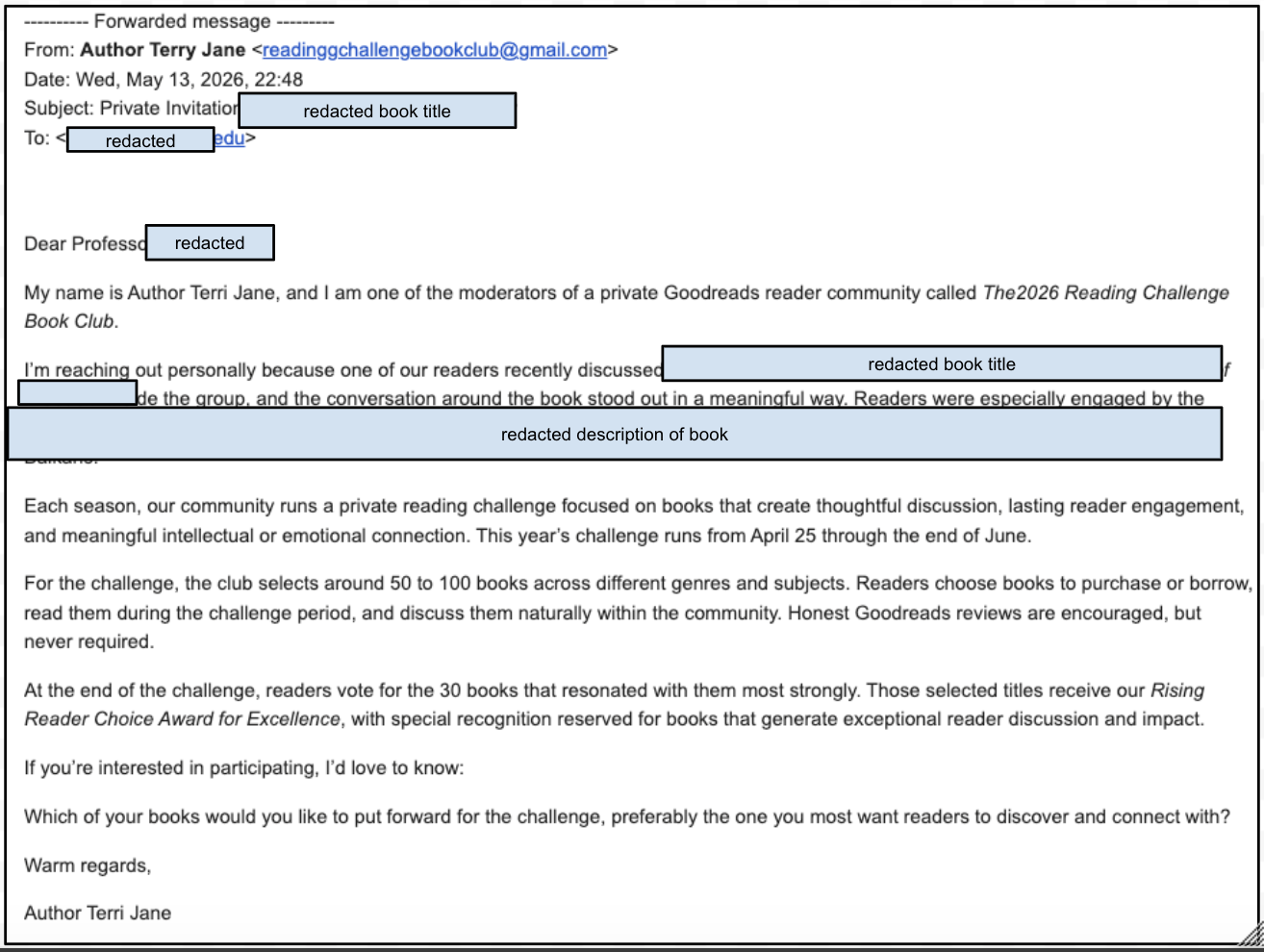
Fraudulent emails target authors with an invitation to have their book included in a curated book club. The email may compliment the author and their work. If the recipient responds, they will receive multiple follow up emails, and eventually they are asked to pay a fee.
How it Works
- The author receives an email from someone they have not met.
- The subject line and email body reference one of the author’s book titles and may provide a descriptive summary of the book.
- The scammer uses a friendly tone and praises the book and the author, saying their book club would like to feature the book.
- In subsequent communication, the book club organizer will provide limited details about how the book club would “feature” the book.
- In one of the emails, the organizer asks the author to pay a fee, which may be described in a variety of ways:
- “administration fee”
- “spotlight fee”
- “honorarium contribution”
- “coordination fee”
- If the author declines, the scammer may stop communicating, or pressure the author by implying they will miss an opportunity.
What to Watch Out For
- Email messages from individuals you do not know that seem “out of the blue.”
- Messages that use flattery or a friendly tone to elicit trust.
- Messages that pressure you to act quickly, e.g. “you may miss an opportunity.”
- Requests for payment.
How to Protect You and the U
- Do not respond to suspicious emails from individuals you do not know.
- Do not send payment or “fees” that are not for verified legitimate services.
- Forward any email communication with the scammer to [email protected]. For more information, see Report Phishing and Email Abuse.
If You Get Caught
Individuals who have fallen victim to one of these scams, which resulted in loss of money, should contact the University of Michigan Police Department at 734-763-1131 or text 377911.
Scam Examples